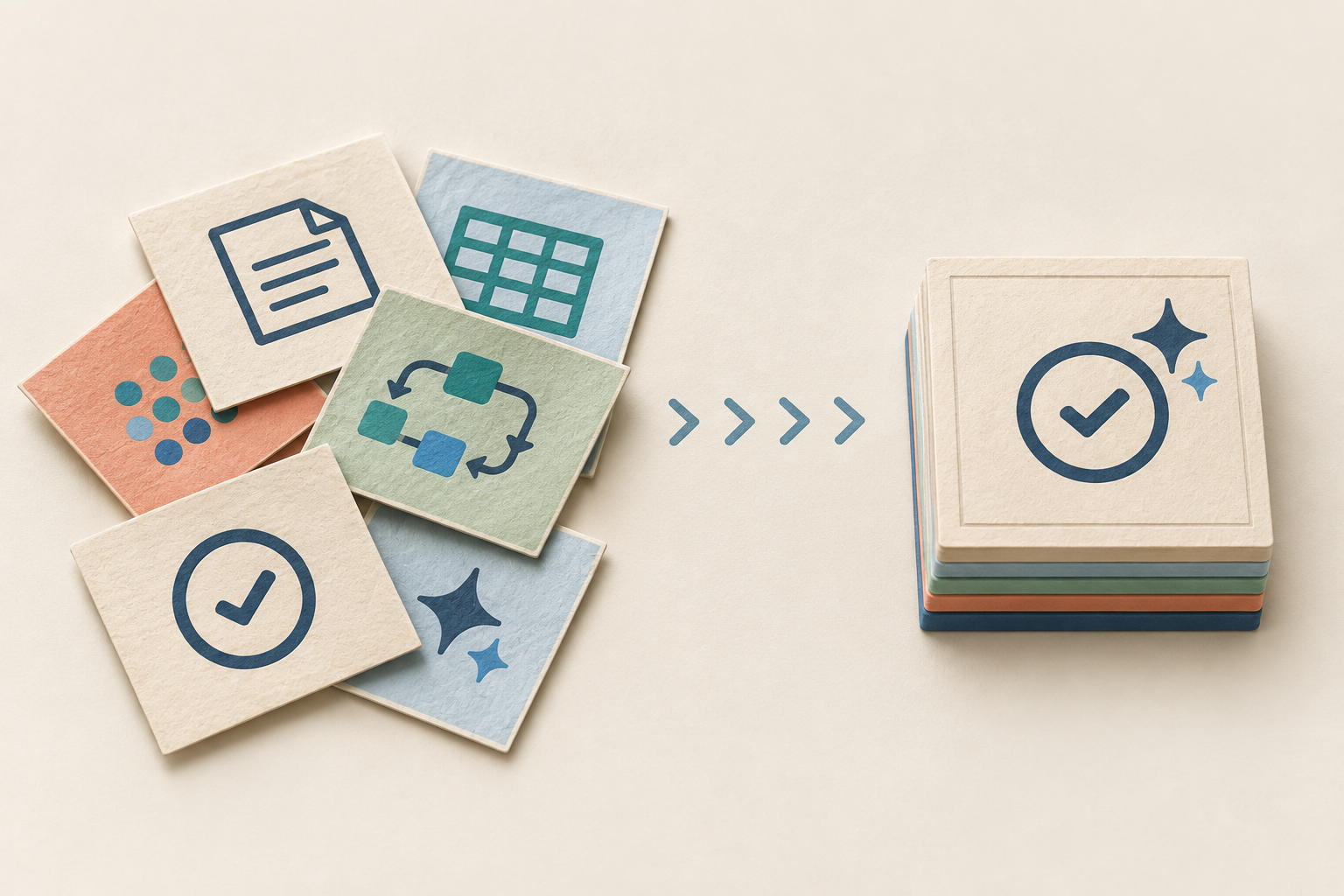

Enterprise knowledge management is moving beyond simple retrieval. The next step is active management: keeping information current, resolving conflicts between sources, and directing people to the right expert when the answer is not sitting cleanly in a document.
In the early wave of generative AI, Retrieval-Augmented Generation (RAG) became the default pattern. It made sense. Point the model at company documents, retrieve relevant passages, and generate an answer. For many organisations, that was a major improvement on search boxes and static intranets.
Now the limitations are becoming clearer.
Many businesses are discovering that naive RAG does a good job of finding text, but a weaker job of deciding what should be trusted. It can surface outdated project plans, duplicate policy versions, conflicting meeting notes, and documents that are technically relevant but operationally stale. In other words, it can retrieve information without truly managing knowledge.
RAG helped, but it did not fix the data graveyard
For years, corporate knowledge management has suffered from the same structural problem: organisations store huge volumes of information, but very little of it is actively maintained. SharePoint sites, wikis, file shares, Teams folders and collaborative workspaces gradually become digital attics. Content accumulates faster than it is reviewed.
RAG was meant to reduce the pain of that sprawl. Instead of asking staff to manually hunt for answers, the model could retrieve likely source material and summarise it.
That works well up to a point. The trouble starts when the underlying library is messy.
If an AI system sees a project document from 2019, a revised spreadsheet from 2024, and a recent Teams discussion that quietly changed the decision again, it may struggle to identify the real source of truth. The model can produce a fluent answer while still blending outdated and current material together.
That is the ceiling many organisations are now hitting.
The shift: from finding knowledge to managing it
The next evolution in knowledge management is a move from passive retrieval to active stewardship.
A strong enterprise AI system should do more than wait for a user to ask a question. It should help maintain the quality of the environment it depends on. That means identifying stale information, spotting conflicts, recognising domain context, and improving the health of the knowledge base over time.
This is where the idea of an agentic librarian becomes useful.
The phrase is simple, but the model behind it is powerful. In a physical library, a good librarian does more than point to a shelf. They know which materials are current, which references are trusted, what has been superseded, and who to speak to when a specialised answer is needed. The digital equivalent should work in much the same way.
What an agentic librarian does
An agentic librarian is a layer of intelligence that actively manages organisational knowledge rather than simply retrieving it.
In practice, that means three core capabilities.
1. Detecting signals of relevance
Not all documents should carry equal weight. Some are heavily used, regularly updated, and frequently cited in active work. Others have been sitting untouched for years.
An agentic system can detect these signals of relevance by looking at patterns such as edits, references, recent activity, linked workflows, and whether material is still part of live decision-making. This helps the business separate active knowledge from archival clutter.
2. Proactive maintenance
The real issue with stale data is rarely storage. It is ownership.
When information starts to rot, someone usually still knows whether it is valid. The challenge is prompting that review before the wrong content is relied on. An agentic librarian can flag ageing or conflicting material and reach out to content owners through the tools they already use, such as email or Teams, to confirm whether the information should be retained, updated, replaced or retired.
This turns knowledge management into a living process instead of an annual clean-up exercise.
3. Signposting experts
Sometimes the best answer is not in a document at all.
In many organisations, the true source of knowledge still sits with subject matter experts across engineering, finance, operations, delivery or compliance. An effective system should recognise when the answer is better handled by a person and then guide the user to the right expert, team or assistant.
That is a practical step forward for enterprise AI. It accepts that knowledge lives in both documents and people.
What this means for decision-makers
For CIOs, CISOs, IT leaders and operational executives, this shift has direct business value.
Knowledge management is an information problem, a risk problem, a productivity problem and a governance problem.
- Risk: teams make poor decisions when outdated or conflicting information is surfaced as if it were current.
- Productivity: staff lose time validating answers when they do not trust the first response.
- Governance: AI outputs become harder to defend when the system cannot explain why one source was used over another.
- Adoption: confidence drops quickly if users feel the assistant sounds helpful but is directionally wrong.
Put simply, a retrieval layer on top of unmanaged content can scale confusion just as easily as it scales access.
An agentic model improves that by adding curation, review loops and context awareness to the knowledge stack.
How Theta Assist supports this model
At Theta Assist, the focus is on helping teams work across the systems they already use rather than forcing every team into one new repository or pretending a single source of truth can be created overnight. Most organisations already operate across a mix of systems, each suited to different workflows.
The goal is to make that environment more usable and more trustworthy through active curation.
Scheduled agentic runs
One of the most practical ways to do this is through scheduled agentic runs.
Instead of relying on a passive search pipeline, these runs can audit knowledge sources on a schedule. They can scan across platforms such as OneDrive, SharePoint and Teams, identify conflicting information, surface documentation gaps, and highlight content that may need human review.
This allows issues to be caught before a user query turns them into an operational problem.
Specialised assistants for different domains
Knowledge context is rarely universal. Engineering, finance, operations and delivery teams each work with different systems, vocabulary and source material.
That is why specialised assistants matter. A technical assistant connected to tools like Azure DevOps and Jira can behave more like an engineering librarian. An assistant connected to Business Central or Dataverse can support financial and operational curation with the right business context.
This domain-specific design helps the AI produce answers that are more relevant and easier to trust.
Connectivity across the real toolset
Enterprise knowledge does not live in one place. A useful knowledge system needs visibility across calendars, emails, files, conversations, line-of-business platforms and workflow tools.
That is why connectivity matters. Using Model Context Protocol (MCP) and Microsoft Graph, Theta Assist can connect across business systems so retrieval is grounded in current context, including who is meeting, what is being discussed, and what work is progressing through operational tools.
This creates a stronger link between stored knowledge and live business activity.
The frontier company will manage knowledge differently
The most capable organisations will not treat AI as a better document search box. They will treat it as part of an active knowledge operating model.
That model allows teams to keep using the systems best suited to their work, whether that is a specialist engineering tool, a finance platform, a Jira board or a shared spreadsheet, while improving the integrity of the knowledge layer that connects them.
The broader industry is already moving in this direction. The era of simply chatting with a pile of documents is giving way to more reflective, agentic systems that can evaluate findings, iterate, and seek stronger grounding before answering.
Final thought
The future of enterprise knowledge management is better retrieval combined with managed intelligence.
That means moving beyond naive RAG and toward systems that can detect relevance, maintain content quality, and connect people with the right expertise. The organisations that do this well will get more than better answers. They will get stronger governance, better operational trust, and a more useful foundation for AI across the business.
Theta Assist is being built for that future: scheduled curation, specialised assistants, and connected enterprise context that helps turn data graveyards back into living knowledge ecosystems.
Book a demo to see how Theta Assist can support a more practical, high-integrity approach to enterprise knowledge management.